Cat Breathing Issues: Signs You Shouldn’t Ignore (Vet Verified)

Most cat owners notice something is off before they can name it. A slightly different posture at rest. Breathing that sounds just a little heavier than usual. A cat that seems fine, but not quite. With breathing issues, that instinct is worth trusting. The signs that matter most in cats are rarely dramatic, and by the time they are, the window for early intervention can often already pass. Let’s dive into cat breathing issues!
What Are Common Cat Breathing Issues?
Cat breathing issues include any change in the rate, effort, or sound of breathing that falls outside a cat’s normal pattern. Common causes range from respiratory infections and asthma to heart disease and fluid accumulation around the lungs. While some breathing changes are mild, others are medical emergencies. A resting respiratory rate consistently above 30 breaths per minute is an early warning sign that warrants veterinary attention.
Key Takeaways
- A healthy cat at rest takes between 20 and 30 breaths per minute; anything consistently above 30 should be evaluated
- Open-mouth breathing in cats is never normal and always requires urgent veterinary care
- The three most common causes of serious breathing difficulty in cats are asthma, heart failure, and pleural effusion (fluid around the lungs)
- Breathing issues can be cardiac or respiratory in origin; both require the same response: prompt veterinary attention
- Tracking resting respiratory rate consistently over time can be a very effective way to detect problems early
Cat Breathing Issues, Explained
Cat breathing problems can present in several ways, each pointing to different possible causes:
- Tachypnea — an elevated respiratory rate (above 30 breaths per minute at rest), which may or may not be accompanied by visible effort
- Dyspnea — labored or difficult breathing, where the cat visibly struggles to inhale or exhale. According to Cornell University College of Veterinary Medicine, dyspnea is not a disease in itself, but an important clinical sign accompanying many feline health conditions
- Open-mouth breathing or panting — unlike dogs, cats do not pant to regulate temperature. Open-mouth breathing in a cat that is not acutely stressed or overheated is always abnormal
- Wheezing or noisy breathing — audible sounds during inhalation or exhalation, which may suggest airway narrowing, obstruction, or fluid
- Shallow or rapid breathing — short, quick breaths that may indicate the lungs cannot expand fully, often due to fluid accumulation
- Extended neck posture — a cat stretching their neck forward and lowering their head while breathing is trying to open their airway and signals significant distress
What Causes Breathing Issues in Cats?
According to Cornell Vet, the three most common causes of serious respiratory distress in cats are feline asthma, heart failure, and pleural effusion. Beyond these, a range of other conditions can affect how a cat breathes.
Feline asthma — one of the most prevalent respiratory conditions in cats, triggered by allergens such as dust, pollen, cigarette smoke, or dusty litter. During an asthma episode, the airways narrow and tighten, making breathing labored. Cats may crouch low, extend their neck, and breathe with visible effort or a wheezing sound.
Heart disease — conditions such as hypertrophic cardiomyopathy (HCM) can lead to fluid accumulation in or around the lungs, directly impairing the ability to breathe. The body attempts to compensate for reduced oxygenation by increasing both breathing rate and depth, meaning a rising respiratory rate can be an early indicator of cardiac compromise before any other symptoms appear.
Pleural effusion — an abnormal accumulation of fluid in the space between the lungs and the chest wall. This fluid compresses the lungs, reducing the space available for them to expand, and produces a characteristic pattern of rapid, shallow breathing.
Upper respiratory infections (URIs) — viral or bacterial infections that inflame the nasal passages, throat, or lungs, causing congestion, sneezing, and noisy or labored breathing. Common in cats, particularly in multi-cat environments or those with a history of outdoor exposure.
Other causes include anaemia, heartworm disease, pulmonary tumors, trauma, foreign objects in the airway, hyperthyroidism, and pain or acute stress, all of which can alter the respiratory pattern in different ways.
“Every time Umi is hospitalized, it’s for like four days and it costs over $5,000… Maven has helped me not only save money but also save his life”
★★★★★
Jessica Ortiz
Umi
What Breathing Changes Are Considered an Emergency?
Some breathing changes require a same-day veterinary assessment. Others require you to go immediately without waiting to see if things improve. The following signs are emergencies:
- Open-mouth breathing at rest — always abnormal in cats, always urgent
- Blue, grey, or pale gums — indicate severe oxygen deprivation
- Breathing with visible abdominal effort — the belly moving significantly with each breath suggests the lungs cannot expand normally
- Flared nostrils — the body’s attempt to bring in more air
- Extended neck posture with elbows held out — the classic “orthopnea” posture in cats struggling to breathe
- Audible breathing sounds at rest — wheezing, crackling, or gurgling
- Sudden rapid deterioration — any dramatic change in breathing pattern that develops over minutes to hours
If your cat shows any of these signs, do not wait. Call ahead to the emergency clinic so they can prepare oxygen support for your cat’s arrival. Any cat showing signs of breathing difficulty is at high risk without prompt treatment, regardless of the cause.
How Can You Check Your Cat’s Breathing at Home?
Monitoring your cat’s resting respiratory rate (RRR) at home is straightforward and one of the most clinically valuable things you can do as a cat owner, particularly for cats with known heart or respiratory conditions.
Here’s how to do it:
- Wait until your cat is in a deep, relaxed sleep — not drowsy or purring (purring can interfere with the count)
- Watch the chest rise and fall — one complete rise and fall counts as one breath
- Count for 30 seconds, then multiply by two to get breaths per minute
- Record the result — note the date, time, and any context
- Repeat several times a week to establish a reliable baseline
A normal resting respiratory rate for a healthy adult cat is generally between 20 and 30 breaths per minute. It’s worth noting that some cats may have a normal baseline on the lower end of this range, which is why individual baselines matter more than population averages. A rate that is consistently elevated above 30, or that has increased noticeably from your cat’s established normal, warrants a call to your vet.
“Changes in a cat’s breathing can be one of the earliest signs that something is wrong, but they are often easy to miss. Monitoring resting respiratory rate over time can help detect problems before more severe symptoms develop.” — Sara Leitão, DVM, Veterinarian at Maven Pet
When Should You Contact a Veterinarian?
As a general rule: when in doubt, call. Cats deteriorate quickly once respiratory distress sets in, and early intervention is significantly more effective than waiting.
Contact your vet promptly — within the same day — if:
- Your cat’s resting respiratory rate is consistently above 30 breaths per minute over multiple readings
- You notice a meaningful increase from your cat’s established normal rate
- Your cat seems mildly lethargic, less active, or less interested in food, alongside any breathing changes
- Breathing seems slightly more effortful than usual, even without obvious distress
Seek immediate emergency care if your cat shows any of the emergency signs listed above: open-mouth breathing, blue gums, severe labored breathing, or sudden collapse.
How Maven Helps
The most actionable early indicator of a developing breathing problem in cats is a sustained rise in resting respiratory rate, often present days before visible distress appears. The challenge is that detecting this trend manually, across multiple readings over days and weeks, is difficult to maintain consistently.

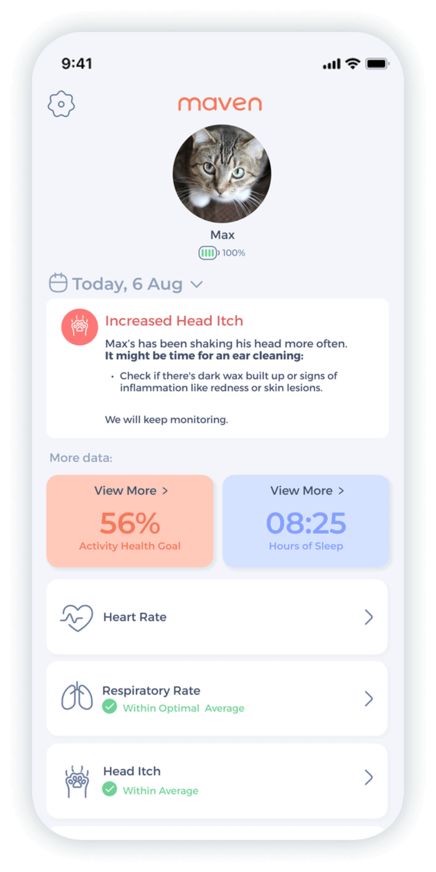
Monitor heart rate, respiratory rate, activity & rest, itch behavior.
The Maven Pet Health Monitor makes this continuous tracking automatic:
- Tracks resting respiratory rate using our dedicated cat respiratory rate tracker, detecting subtle increases in breathing rate before they become visible
- Monitors heart rate trends via the cat heart rate tracker, which may shift in response to respiratory compromise or cardiac strain
- Measures daily activity levels through the cat health tracker, identifying reductions in movement or play that can accompany the onset of breathing difficulty
- Tracks rest and sleep patterns, detecting disrupted or increased rest that may reflect discomfort or fatigue caused by compromised breathing
- Builds a personalized baseline through the pet health tracker, defining what normal resting respiratory rate and activity look like for your individual cat — so meaningful deviations are flagged accurately
- Sends alerts when deviations occur, such as a rising resting respiratory rate or a sustained drop in activity — giving you and your vet a concrete reason to act, earlier
Used alongside regular veterinary check-ups, the Maven Pet Health Monitor turns at-home observation from a passive activity into an active early detection system, particularly valuable for cats with known cardiac or respiratory conditions, or those at higher breed-related risk.
FAQ (Vet-Reviewed)
The most common serious causes are feline asthma, heart failure, and pleural effusion (fluid around the lungs). Other causes include upper respiratory infections, anaemia, heartworm, pulmonary tumors, and systemic conditions such as hyperthyroidism. Acute stress or pain can also temporarily alter breathing patterns.
A healthy cat at rest takes between 20 and 30 breaths per minute, breathing quietly with their mouth closed. Signs of abnormal breathing include a rate consistently above 30 at rest, open-mouth breathing, visible chest or abdominal effort, audible sounds, flared nostrils, or an extended neck posture.
Fast breathing becomes an emergency when it is accompanied by open-mouth breathing, blue or pale gums, severe visible effort, or a sudden, rapid change in condition. Any of these signs requires immediate veterinary attention. When in doubt, call your vet or emergency clinic — do not wait to see if it resolves.
Yes. Heart disease, particularly hypertrophic cardiomyopathy, can lead to fluid accumulation in or around the lungs, directly compromising the ability to breathe. A rising resting respiratory rate is often one of the earliest measurable signs that the heart is under stress, frequently appearing before other symptoms become visible.
Count your cat’s breaths per minute while they are in a deep sleep — one rise and fall of the chest equals one breath. Count for 30 seconds and multiply by two. Repeat regularly and keep a record. A resting respiratory rate consistently above 30 breaths per minute, or a noticeable increase from your cat’s normal, is worth discussing with your vet.
Conclusion
Cat breathing issues exist on a spectrum. From the subtle and gradual to the sudden and severe. What makes them particularly difficult is that cats are so effective at masking discomfort.
The most reliable protection is knowing your cat’s normal. A consistent record of their resting respiratory rate over time is not just a number; it’s context. It’s the difference between noticing that something has shifted and only realizing it once things have already become serious.
Maven Pet focuses on improving the quality of life of our pets with technology, using artificial intelligence (AI) to enable proactive pet care. By accurately collecting and monitoring pet data 24/7 and flagging any irregularities, Maven Pet empowers pet parents and veterinarians to stay ahead of potential health issues, ensuring the well-being and longevity of our beloved companions.